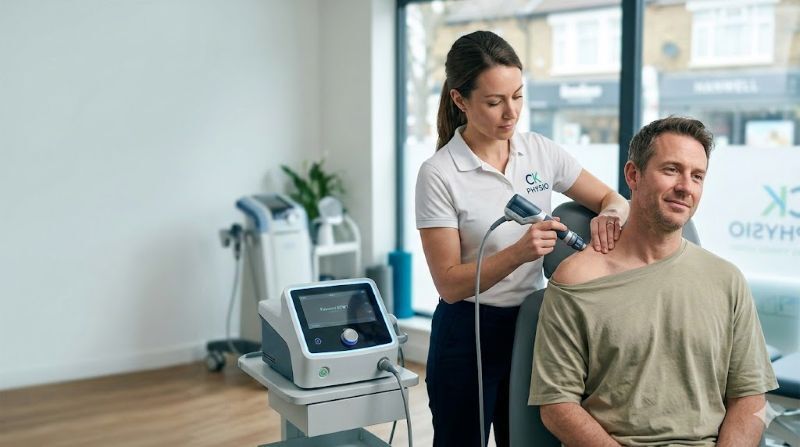

Shockwave Therapy • Evidence-Based Treatment
If you're reading this, you're likely dealing with shoulder or neck pain that hasn't responded well to rest, painkillers, or perhaps even cortisone injections. You might have heard about shockwave therapy and wondered whether it could finally provide the relief you're looking for.
Shockwave Therapy for Shoulder and Neck Pain: What the 2026 Research Tells Us
A comprehensive guide from CK Physio on the latest clinical evidence, realistic expectations, and why our focused shockwave approach may help when other treatments haven't.
Focused shockwave therapy (ESWT) remains one of the strongest evidence-backed non-invasive treatments for chronic shoulder conditions, with calcific tendinitis patients achieving good-to-excellent outcomes in 60–91% of cases. Recent research has strengthened the case for focused ESWT over radial devices, shown that ultrasound-guided targeting can nearly double success rates, and established international consensus on treatment protocols. At CK Physio, we use focused Piezowave 2 technology as part of a comprehensive rehabilitation approach—because the evidence shows that shockwave therapy works best when integrated with expert physiotherapy care.
At CK Physio, we believe you deserve honest, evidence-based information to make informed decisions about your treatment. This article shares what the latest 2026 research actually tells us about shockwave therapy for shoulder and neck conditions—including where the evidence is strong, where it's still developing, and what realistic outcomes you might expect.
We'll also explain why we invested in focused shockwave technology rather than the more common radial devices, and how our approach integrates shockwave therapy with comprehensive physiotherapy care—because the research consistently shows that combination produces the best results.
Which shoulder conditions respond best to shockwave therapy?
The evidence for shockwave therapy varies significantly depending on your specific shoulder condition. Understanding these differences helps set realistic expectations and ensures you receive appropriate treatment.
Calcific tendinitis: The strongest evidence
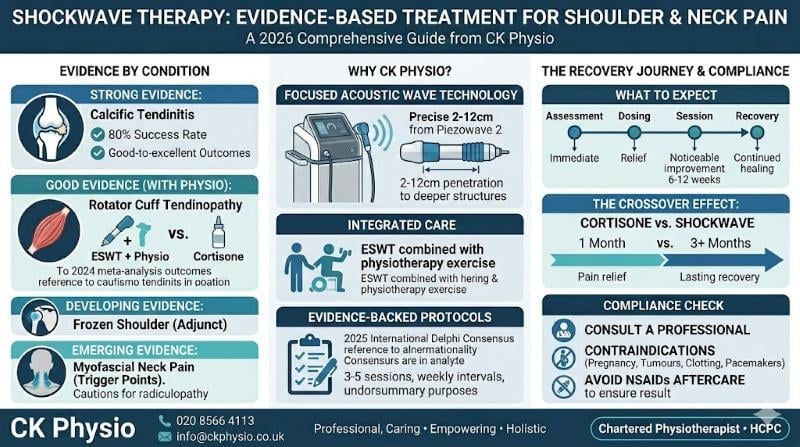
If you have calcium deposits in your rotator cuff tendons, shockwave therapy offers some of the best outcomes of any non-invasive treatment. Research consistently shows approximately 80% of calcific tendinitis patients achieve good-to-excellent outcomes at 18-month follow-up, with complete calcium dissolution in 50–66% of cases.
A pivotal 2025 study published in Diagnostics demonstrated that ultrasound-guided focused ESWT achieved a 90.9% success rate compared to 50% with standard landmark-based targeting. This represents one of the most significant recent advances in shockwave treatment—precise imaging guidance can nearly double your chances of a successful outcome.
Rotator cuff tendinopathy: Good evidence with combination therapy
A comprehensive 2024 meta-analysis by Xue and colleagues, published in BMC Musculoskeletal Disorders, analysed 16 randomised controlled trials involving 1,093 patients with rotator cuff tendinopathy. The findings showed ESWT significantly improved pain scores, Constant-Murley functional scores, and overall treatment effectiveness compared to control treatments.
Importantly, a separate 2024 network meta-analysis ranked ESWT combined with conventional physiotherapy as the most efficient intervention for shoulder impingement syndrome—outperforming cortisone injections, which improved composite scores but didn't significantly affect pain intensity or mobility in isolation.
This is exactly why CK Physio's approach integrates shockwave therapy within a comprehensive physiotherapy treatment plan—the evidence shows shockwave works best as part of your rehabilitation, not as a standalone quick fix.
Frozen shoulder: Developing evidence as an adjunct treatment
For frozen shoulder (adhesive capsulitis), the evidence is more modest but still encouraging. A 2022 systematic review of 20 randomised trials found ESWT provides effective adjunct therapy, with immediate pain reduction and sustained improvement at 4 weeks, 8 weeks, and 6-month follow-up when added to standard physiotherapy care.
Evidence Summary by Condition
A note on honesty: The authoritative Cochrane Review (2020) concluded that ESWT "probably does not improve pain and function compared to placebo" for rotator cuff disease overall. More recent meta-analyses show more positive results, particularly when ESWT is combined with physiotherapy and when calcific versus non-calcific conditions are analysed separately. At CK Physio, we believe you should know about this ongoing scientific debate—and we'll always be honest about what we can and cannot promise for your specific condition.
Can shockwave therapy help with neck pain?
Shockwave therapy for myofascial neck pain represents an emerging but promising area. If you're dealing with persistent tension in your upper trapezius or chronic trigger points that haven't responded to conventional treatments, the evidence suggests ESWT may offer meaningful relief.
A 2022 meta-analysis published in Annals of Translational Medicine, covering 8 studies and 571 patients, found that ESWT achieved significantly better pain reduction for neck and upper trapezius myofascial pain than other modalities—including trigger point injection, dry needling, and pulsed radiofrequency.
A 2025 scoping review confirmed ESWT's effectiveness for myofascial pain syndrome, though it noted outcomes are "not substantially superior" to conventional treatments. The major research gap is the absence of a standardised therapeutic protocol for neck conditions.
At CK Physio, we've seen positive outcomes using focused shockwave for appropriate neck pain cases—particularly those involving chronic myofascial trigger points that haven't responded to manual therapy alone. However, we'll always assess your individual situation to determine whether shockwave is the right approach for you.
Important: There is currently no evidence supporting shockwave therapy for cervical radiculopathy (nerve-related neck pain radiating down the arm). If you're experiencing these symptoms, we'll discuss alternative treatment approaches and may refer you for further investigation.
Why CK Physio uses focused shockwave therapy
Not all shockwave therapy is the same. Most physiotherapy clinics use radial shockwave devices, which are less expensive and easier to operate. At CK Physio, we invested in focused shockwave technology (the Piezowave 2 by Richard Wolf) because the research suggests it delivers better long-term outcomes—particularly for deeper structures like the shoulder and neck.
The key differences come down to precision and penetration depth. Focused shockwave delivers concentrated energy at an adjustable depth of 2–12 cm, targeting the exact problem area. Radial shockwave disperses energy from the surface and penetrates only 3–4 cm, making it less suitable for deeper shoulder and neck structures.
The only direct head-to-head randomised trial comparing focused versus radial ESWT for shoulder tendinopathy (Li et al., 2021) found no short-term difference—but significant focused ESWT superiority at 24 and 48 weeks. At 48 weeks, pain scores were 1.4 for focused versus 3.0 for radial treatment, and 100% of focused ESWT patients showed MRI improvement of at least one grade compared to 50% in the radial group.
We should acknowledge this evidence comes from a single trial, and some guidance suggests there's no statistically significant difference between modalities overall. However, combined with the biomechanical rationale—focused waves reach deeper, more precisely—we believe the investment in focused technology gives you the best chance of a successful outcome.
Shockwave therapy versus cortisone injections
If you've been offered a cortisone injection for your shoulder pain, you might be wondering how it compares to shockwave therapy. The research reveals an interesting pattern that we call the "crossover effect."
Cortisone injections typically provide faster short-term relief—they're often noticeably better in the first 4 weeks. However, shockwave therapy delivers superior medium- and long-term outcomes from 3 months onwards.
A 2024 meta-analysis published in Orthopaedic Surgery quantified this for lateral epicondylitis: at 1 month, cortisone was better. At 3 months, ESWT was better. At 6 months, the gap widened further in ESWT's favour. This pattern appears consistent across multiple shoulder and elbow studies.
The choice often depends on your priorities. If you need rapid relief for an important event or simply can't wait for gradual improvement, a cortisone injection might be appropriate. If you're focused on lasting recovery and want to avoid repeated injections, shockwave therapy combined with comprehensive physiotherapy may be the better long-term investment.
What to expect from shockwave treatment at CK Physio
Understanding the treatment process helps you prepare and set realistic expectations. Here's what your shockwave therapy journey at our Hanwell clinic typically involves.
The treatment protocol
Based on the 2025 International Delphi Consensus and updated ISMST guidelines, the standard protocol involves 3–5 sessions scheduled at weekly intervals. Each session lasts 15–20 minutes (45 minutes for your initial assessment), with approximately 1,500–3,000 shockwave impulses delivered per session.
We use a pain-adapted dosing approach—starting at lower energy levels and gradually increasing to your tolerance, typically around 5 out of 10 on a pain scale. This ensures the treatment is effective whilst remaining comfortable.
Recovery timeline
Most patients experience some immediate relief from the treatment session itself—this is due to hyperstimulation analgesia, a temporary effect. The real therapeutic benefits emerge after 2–3 sessions over several weeks, with noticeable improvement typically occurring within 6–12 weeks. Full tissue regeneration benefits continue developing over months.
Side effects and safety
Shockwave therapy has an excellent safety profile. NICE has confirmed the safety of ESWT, and the international clinical body (ISMST) considers it the treatment of first choice for calcific tendinopathy. Common transient side effects include temporary pain increase, skin redness, minor bruising, and local swelling—all typically resolving within days.
There are specific contraindications we'll screen for during your assessment, including pregnancy, malignant tumours in the treatment area, open wounds, pacemakers, and certain blood clotting disorders. We'll also ask about recent cortisone injections—the guidelines recommend waiting at least 6 weeks.
Important aftercare instructions
One of the most common misconceptions is that you should take anti-inflammatory medication after shockwave therapy. In fact, NSAIDs should be avoided post-treatment because they may interfere with the intentional inflammatory healing cascade that shockwave therapy triggers. We'll provide detailed aftercare guidance, including recommended exercises to support your recovery.
Treatment costs and insurance
CK Physio offers shockwave therapy at £360 for an assessment plus 3 sessions, or £295 for 3 sessions without assessment if you've recently been assessed. This represents competitive mid-range pricing for London—comparable clinics charge £275–£395 for similar packages, whilst specialist focused shockwave clinics may charge significantly more.
We're registered with BUPA and AXA PPP, and shockwave therapy is covered under physiotherapy benefits by most major health insurers including BUPA, AXA Health, Aviva, Vitality, Healix, Cigna, WPA, and Allianz. Pre-authorisation is typically required, and we can guide you through this process.
To discuss your treatment options or book your initial assessment, contact us on 020 8566 4113 or email info@ckphysio.co.uk.
Frequently asked questions
Is shockwave therapy right for you?
If you've been dealing with chronic shoulder or neck pain that hasn't responded to rest, medication, or conventional physiotherapy, shockwave therapy may offer the breakthrough you've been looking for—particularly if you have calcific tendinitis, chronic rotator cuff tendinopathy, or myofascial trigger points.
At CK Physio, we take an evidence-based, honest approach. We'll assess your specific condition, discuss realistic expectations based on the current research, and recommend the treatment approach most likely to help you. Sometimes that means shockwave therapy as part of a comprehensive plan; sometimes it means alternative approaches entirely.
Our Chartered Physiotherapists are registered with the Health and Care Professions Council and members of the Chartered Society of Physiotherapy. We use focused Piezowave 2 technology—not the more common radial devices—because the evidence suggests it delivers better long-term outcomes for the deeper structures we typically treat.
To find out whether shockwave therapy could help your shoulder or neck pain, contact us to arrange an initial assessment. We're here to help you make informed decisions about your treatment and support your recovery every step of the way.
Ready to discuss your treatment options?
Book your initial assessment at CK Physio, Hanwell
Book NowOr call us: 020 8566 4113 • Email: info@ckphysio.co.uk
References
- Xue X, Song Q, Yang X, et al. Effect of extracorporeal shockwave therapy for rotator cuff tendinopathy: a systematic review and meta-analysis. BMC Musculoskeletal Disorders. 2024;25:357. https://doi.org/10.1186/s12891-024-07445-7
- National Institute for Health and Care Excellence (NICE). Extracorporeal shockwave therapy for calcific tendinopathy in the shoulder. IPG742. November 2022. https://www.nice.org.uk/guidance/ipg742
- Wang CJ, Ko JY, Chen HS. Treatment of calcifying tendinitis of the shoulder with shock wave therapy. American Journal of Sports Medicine. 2003;31(3):425-430. PMID: 12750138
- Wu YT, Ho TY, Chou YC, et al. Extracorporeal shock wave therapy for myofascial pain syndrome of the upper trapezius: a systematic review and meta-analysis. Annals of Translational Medicine. 2022;10(3):135. PMID: 35280447
- Li W, Wu G, Xue J, et al. Focused versus radial shockwave therapy for rotator cuff tendinopathy: a randomised controlled trial. BioMed Research International. 2021;2021:9928760. PMID: 34568500
- Rhim HC, Kim MS, Choi S, et al. International Delphi consensus on best practice for shockwave therapy in musculoskeletal conditions. British Journal of Sports Medicine. 2025 (published online ahead of print).
- Surace SJ, Deitch J, Johnston RV, Buchbinder R. Shock wave therapy for rotator cuff disease with or without calcification. Cochrane Database of Systematic Reviews. 2020;3:CD008962. PMID: 32213970
- Zhang D, Meng Y, Zou L, et al. Comparison of the efficacy of extracorporeal shock wave therapy versus local corticosteroid injection for chronic lateral epicondylitis: a systematic review and meta-analysis. Orthopaedic Surgery. 2024;16(6):1387-1395. PMID: 38725249




.svg)

.svg)

.svg)