
23. December 2016
Muscle imbalance and poor posture affect up to 70% of UK office workers and are linked to 80% of chronic lower back pain cases. At CK Physiotherapy in Hanwell, we help West London patients break the cycle of tight muscles pulling the skeleton out of alignment — through targeted manual therapy, corrective exercise, and postural retraining. Most patients see measurable improvement within 4–6 weeks.
Key Takeaway
Muscle imbalance and poor posture are self-reinforcing — tight muscles pull your skeleton out of alignment, which weakens underused muscles further. Physiotherapy breaks this cycle using manual therapy, corrective exercises, and postural retraining. Expect measurable change within 4–6 weeks; long-standing imbalances typically resolve over 8–16 weeks with consistent work.
The Posture Problem by the Numbers
70%
of UK office workers report neck & shoulder pain
27 kg
extra load on the cervical spine from forward head posture
80%
of chronic lower back pain involves muscle imbalance
4–6 wks
typical time to measurable improvement with physiotherapy
What Causes Muscle Imbalance and Poor Posture?
Muscle imbalance develops when certain muscle groups become disproportionately stronger or tighter than their opposing muscles. This happens when some muscles are chronically overused while others remain underactive — typically driven by prolonged sitting, repetitive movement, poor ergonomics, and heavy screen use. Poor posture is the visible consequence: the skeleton is pulled out of its optimal alignment, forcing joints, ligaments, and remaining muscles to work inefficiently.
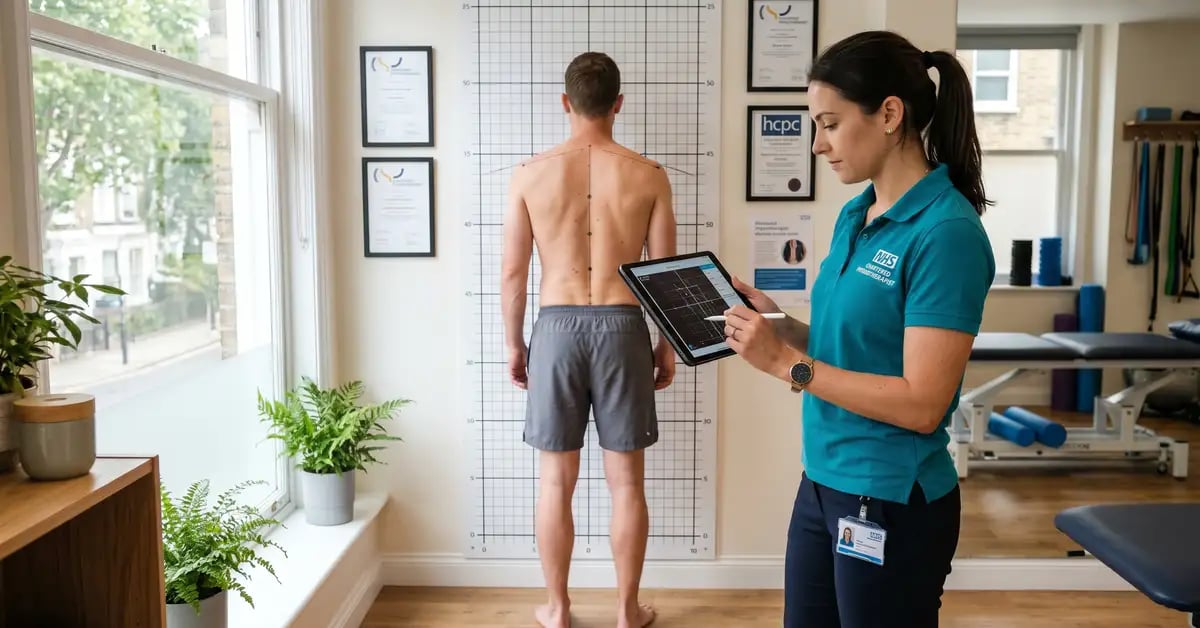
Digital postural analysis at our Hanwell clinic identifies subtle asymmetries invisible to the naked eye.
Our modern environment creates the perfect storm for these dysfunctions. The average UK adult spends more than 7 hours daily on digital devices, often hunched forward. Sedentary work patterns weaken the core and glutes while tightening hip flexors and chest muscles. Even physically active individuals develop imbalances through sport-specific training that favours certain muscle groups — think tennis serving arm, cyclist's hip flexors, or runner's dominant quadriceps.
Stress plays an underappreciated role. Psychological tension manifests physically as upper trapezius and jaw bracing, perpetuating the dysfunction. This is why at CK Physio we assess not just biomechanics but lifestyle, occupation, and stress patterns during every initial consultation.
The Vicious Cycle: How Imbalance Becomes Poor Posture
Muscle imbalance and poor posture reinforce each other in a closed loop. Imbalanced muscles pull the skeleton into abnormal alignment. That new position overloads some structures while underloading others. Overloaded muscles tighten further; underloaded ones weaken. The pattern deepens.
Classic example — the desk worker cascade: tight hip flexors from sitting tilt the pelvis forward, overactivating the lower back and switching off the glutes. The ribcage then compensates by pulling forward, rounding the shoulders, and pushing the head into a jutting position to keep the eyes level. Every section of the kinetic chain adapts — and every adaptation creates its own pain point.
What Are the Most Common Postural Patterns?
The four most common postural patterns physiotherapists diagnose are upper crossed syndrome (forward head + rounded shoulders), lower crossed syndrome (anterior pelvic tilt), sway back (pelvis ahead of ankles), and scoliosis-related asymmetry. Each has a signature pattern of tight and weak muscles, and each requires a different treatment emphasis.
What Are the Warning Signs of Muscle Imbalance?
The five clearest warning signs are uneven posture (one shoulder higher, head tilted), asymmetrical movement (difficulty balancing on one leg versus the other), recurring aches without obvious injury, restricted range of motion, and changes in gait or walking pattern. Catching these signs early prevents the more serious complications that develop when the body remodels itself around dysfunction.
Watch for these specific red flags in daily life:
- Uneven shoulders or hips — check in a mirror wearing a fitted top.
- Head tilts to one side in photos or when looking straight ahead.
- Persistent neck, shoulder, or lower back ache that comes and goes with no clear injury history.
- Difficulty balancing on one leg compared with the other.
- Restricted rotation — struggling to check your blind spot when driving.
- Shoes wearing unevenly — a sign of gait asymmetry.
- Headaches that start at the base of the skull — often cervicogenic, linked to forward head posture.

Forward head posture ('tech neck') places up to 27 kg of extra load on the cervical spine.
What Happens If Muscle Imbalance Is Left Untreated?
Without intervention, muscle imbalance progresses from minor annoyance to structural problem. Uneven joint loading accelerates cartilage wear — the early pathway to osteoarthritis. Forward head posture increases cervical disc pressure up to fivefold, raising herniation risk. Proprioception (the body's positional sense) diminishes, which matters hugely in older adults because reduced proprioception is a leading cause of falls.
Over years, the body actually remodels bone in response to habitual postural loads. That remodelling is why untreated postural problems become harder — though rarely impossible — to correct with time. Early intervention matters.
How Does Physiotherapy Treat Muscle Imbalance and Poor Posture?
Physiotherapy treats muscle imbalance and poor posture through a sequence of detailed assessment, hands-on manual therapy to release tight structures, targeted strengthening of underused muscles, and postural retraining so the nervous system adopts new movement patterns. The goal is not to reach an arbitrary 'perfect posture' but to restore balanced loading so your body can work efficiently.
1. Comprehensive Assessment
At CK Physiotherapy in Hanwell, assessment goes well beyond visual observation. We combine digital postural analysis software with functional movement screening, dynamic gait analysis, selective tissue tension testing, and load-transfer assessment. This lets us pinpoint the true driver — distinguishing neural tension from joint restriction from muscle tightness — so treatment targets the cause, not just the site of symptoms.
2. Manual Therapy
Hands-on techniques restore tissue length and joint mobility in the first 2–4 sessions. The main tools:
- Myofascial release — sustained gentle pressure to restore fascial glide, particularly effective for upper trapezius tension.
- Muscle energy techniques — using post-isometric relaxation to lengthen chronically short muscles like hip flexors.
- Joint mobilisation — gentle oscillatory movements to restore motion in stiff segments, especially the thoracic spine.
- Trigger point therapy — precise pressure on hyperirritable bands to release referred pain patterns.
3. Corrective Exercise and Neuromuscular Re-education
Manual therapy creates a window; exercise makes the change stick. We prescribe specific exercises to wake up the inhibited muscles identified during assessment — deep neck flexors for tech neck, transversus abdominis for core stability, gluteus medius for hip alignment. These are practised under clinical supervision first, then progressed into a home programme.
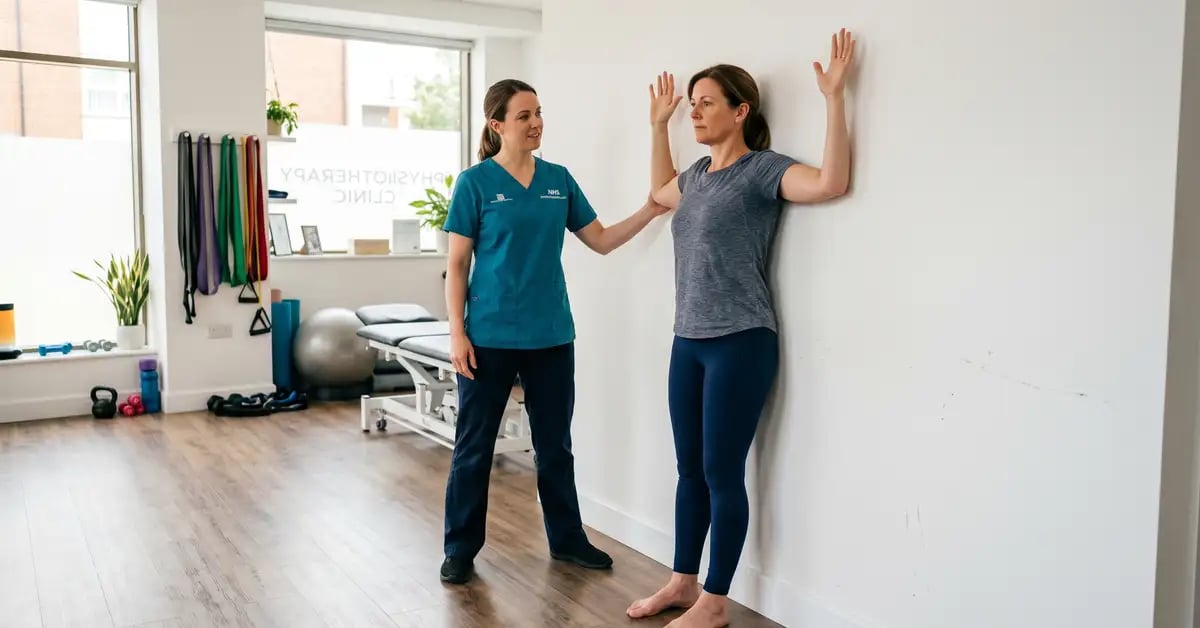
Wall angels activate weak mid-back muscles while stretching tight pectorals.
4. Adjunctive Electrotherapy and Advanced Modalities
For some patients, modalities accelerate recovery. Shockwave therapy helps break chronic tendinopathies that have developed around poor posture (supraspinatus tendinitis, lateral epicondylitis). Therapeutic ultrasound increases tissue extensibility before stretching. Electrotherapy — including NMES for waking up weak muscles and TENS for pain management — supports the active rehabilitation phase. Biofeedback gives patients real-time awareness of muscle activation they cannot otherwise feel.
5. Postural Retraining
The final piece is changing the habits that created the problem. We work with patients on workstation ergonomics, phone-use habits, sleep positioning, and movement breaks. For corporate clients, this extends to on-site DSE (Display Screen Equipment) assessments and posture workshops.
Struggling with persistent neck, shoulder, or back pain from desk work?
A CK Physio postural assessment identifies the specific imbalances behind your pain and gives you a clear plan to fix them.
Book a Postural Assessment →Which Physiotherapy Techniques Work Best for Different Imbalances?
Not every technique suits every problem. This matrix reflects what we use first-line for the most common postural patterns seen in our Hanwell clinic.
What Home Exercises Help Muscle Imbalance and Posture?
The most effective home exercises are chin tucks for forward head posture, wall angels for rounded shoulders, glute bridges for anterior pelvic tilt, banded external rotations for shoulder stability, and thoracic extension over a foam roller. Consistency matters more than intensity — a daily 10-minute routine produces better results than an occasional hour-long session.
- Chin tucks — sitting tall, gently draw your chin straight back keeping the gaze level. 10 reps, 5-second hold, 3× daily. Targets weak deep neck flexors.
- Wall angels — stand back against a wall, arms in a 'W', slowly slide arms up while keeping contact. 10 reps, 2× daily. Activates mid-trap and stretches pecs.
- Glute bridges — lying on your back, knees bent, lift hips while squeezing the glutes. 15 reps, hold 3 seconds at the top. 2× daily. Fires up often-inhibited glutes.
- Banded external rotations — elbow at your side, 90 degrees, rotate forearm outward against a band. 12 reps/side, 2× daily. Strengthens rotator cuff.
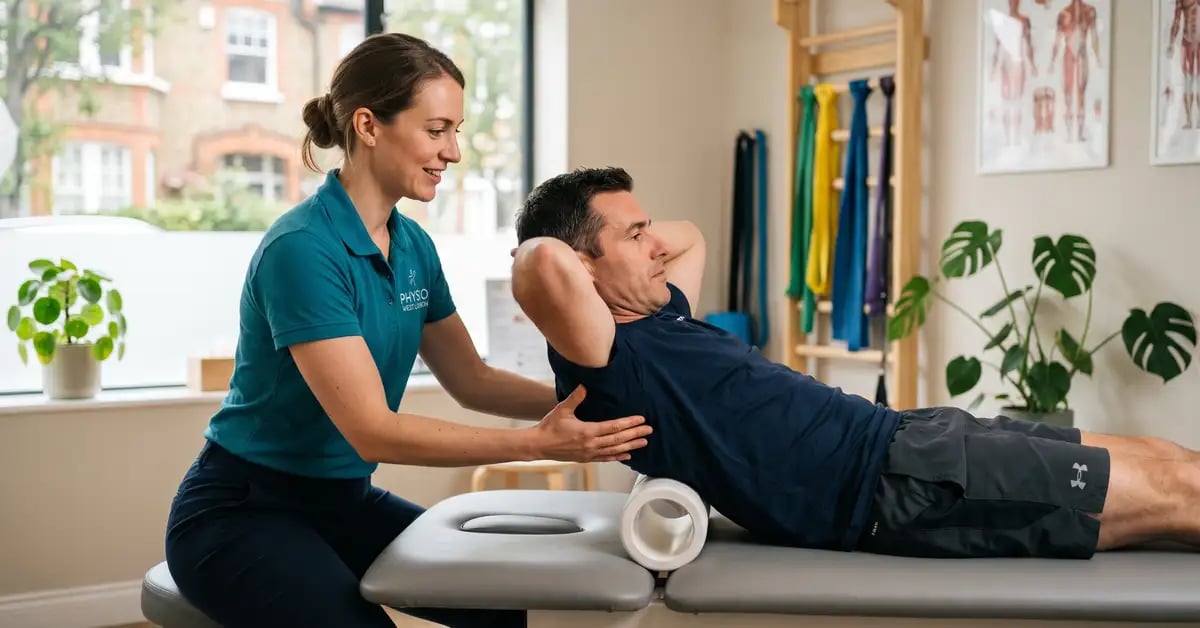
- Thoracic extension over a foam roller — roller horizontal under your upper back, hands supporting head, gently extend over the roller. 60–90 seconds. Counters desk flexion.
Your physiotherapist will adjust reps, sets, and progression based on your specific pattern. Do not self-diagnose — if you don't know which pattern you have, the exercises that help one problem can worsen another.
How Long Does It Take to Fix Poor Posture?
Most patients notice measurable improvement within 4–6 weeks of consistent physiotherapy combined with daily corrective exercises. Fully resolving long-standing imbalances typically takes 8–16 weeks depending on severity and duration. Postural habits are held by the nervous system as much as the muscles, and the nervous system needs repeated exposure to new patterns to rewire.
A typical treatment arc at CK Physio:
Weeks 1–2
Detailed assessment, manual therapy to release tight structures, pain reduction, first home exercises.
Weeks 3–6
Strengthening inhibited muscles, movement re-education, progression of home programme, ergonomic advice.
Weeks 7–12
Functional integration — taking changes into sport, work, and daily activity. Spaced follow-ups.
Beyond 12 weeks
Quarterly maintenance check-ins, advanced conditioning, prevention of recurrence.
Can Physiotherapy Help if My Posture Has Been Poor for Decades?
Yes — it is never too late to improve muscle balance and posture, though the process takes longer when patterns are deeply established. The body retains meaningful adaptability throughout life. We regularly work with West London patients over 60 and 70 who achieve real reductions in pain and measurable improvements in function, even after decades of postural dysfunction.
The goals shift with age and starting point. For a 30-year-old desk worker, full correction is often achievable. For a 70-year-old with long-standing kyphosis, the goal is reducing pain, preventing further decline, and maintaining independence — and that is almost always achievable.
Home Visits for Patients Who Cannot Travel
CK Physio is one of the few West London clinics offering home visit physiotherapy. For elderly patients, post-surgical patients, or anyone for whom travelling to a clinic is difficult, we bring the assessment and treatment to you. Home visits are particularly valuable for postural work because we can see — and adapt — the chair, bed, and workstation that created the problem in the first place.

Home visits let us assess and adjust the actual environment creating the postural problem.
How Do I Prevent Muscle Imbalance and Poor Posture?
Prevention comes down to varied movement, ergonomic workstation setup, regular posture breaks, and balanced strength training. No single habit matters as much as the cumulative effect of small, consistent choices made dozens of times per day.
Workstation Setup
- Monitor at eye level, arm's length away.
- Keyboard and mouse positioned so elbows rest at 90 degrees.
- Chair supporting the natural lumbar curve.
- Feet flat on the floor or a footrest.
- Document holder at the same height as the screen to avoid constant neck flexion.
Mobile Device Habits
- Raise the phone to eye level rather than looking down.
- Use speaker or headphones for longer calls.
- Take a micro-break every 20 minutes of screen time.
Daily Movement Habits
- Break up prolonged sitting with 2–3 minutes of movement every 30 minutes.
- Alternate sides when carrying one-sided loads (shopping bags, shoulder bags).
- Use a backpack with both straps instead of a single-strap bag for heavy loads.
- Schedule at least two weekly sessions of complementary activity — swimming, Pilates, tai chi, yoga — that works movement patterns opposite to your daily defaults.
When to Stop Self-Managing and Seek Help
See a chartered physiotherapist if pain persists beyond 2 weeks of ergonomic changes, if you have restricted movement you cannot work around, if you have numbness or tingling down a limb, or if posture has noticeably changed (one shoulder sitting higher, increased upper-back rounding). Do not wait until pain stops you functioning.
Frequently Asked Questions
How long does physiotherapy take to correct muscle imbalance?
Most patients notice measurable improvement within 4–6 weeks of consistent physiotherapy and daily corrective exercises. Fully resolving long-standing imbalances typically takes 8–16 weeks. Structural adaptations from decades of poor posture may need longer-term intervention, but meaningful improvement is achievable at any age.
Can physiotherapy permanently fix poor posture?
Yes — when combined with ongoing home exercises and ergonomic changes. Physiotherapy addresses both the muscular root causes and the movement habits that maintain them. The improvement is permanent if you keep up the home programme. If you revert to old habits without the exercises, the pattern will gradually return.
Does poor posture actually cause back pain?
Yes — research shows 80% of chronic lower back pain cases involve muscle imbalance, and poor posture is a major driver. Forward head posture alone places up to 27 kg of additional load on the cervical spine. That said, back pain is multifactorial — sleep, stress, and general activity levels also matter.
Can children develop postural problems?
Increasingly yes. Heavy backpacks, extended screen time, and reduced physical activity mean about 60% of adolescents now show early postural abnormalities. Childhood and adolescence are the easiest times to correct these patterns because growing bodies respond quickly. If your child has rounded shoulders, forward head posture, or recurring neck or back ache, a physiotherapy assessment is worth it.
Do I need a GP referral for physiotherapy?
No — physiotherapy in the UK is available through direct access. You can book directly at CK Physio in Hanwell without a GP referral. As autonomous HCPC-registered practitioners, our physiotherapists can assess your condition and decide on treatment. If we identify an issue requiring medical attention, we liaise with local GPs and specialists for a seamless onward referral.
Will my private medical insurance cover postural physiotherapy?
Most major UK private medical insurers — including BUPA and AXA PPP — cover physiotherapy for musculoskeletal conditions where muscle imbalance or poor posture is a contributing factor. CK Physio is registered with both. Policy terms vary, so check your cover level and whether a GP referral is required for reimbursement.
Ready to fix the root cause?
Book a postural assessment at CK Physio
22 years serving Hanwell & Ealing. HCPC-registered, insurer-approved (BUPA, AXA PPP). Clinic appointments or home visits across West London. Most patients see measurable change in 4–6 weeks.
Book an Assessment → Ask a QuestionAbout CK Physiotherapy
Founded in 2003 by Chartered Physiotherapist Clwyd Probert, CK Physiotherapy has been serving Hanwell, Ealing, and wider West London for more than 22 years. Our multi-disciplinary team is HCPC-registered, CSP-accredited, and approved by the major UK private medical insurers. We specialise in holistic, non-invasive care — combining manual therapy, corrective exercise, shockwave, electrotherapy, therapeutic ultrasound, and home visits to help patients return to the activities they value.
Sources & Further Reading: Chartered Society of Physiotherapy — Back Pain Resources; NHS — Common Posture Mistakes and Fixes; HCPC — Check a Physiotherapist's Registration; Page P., Frank C., Lardner R. Assessment and Treatment of Muscle Imbalance: The Janda Approach — foundational text on postural syndromes.
Epsom salt baths for muscle recovery
sharp pain when sneezing complete guide to trapped nerves in the neck and shoulders physiotherapy guide for frozen shoulder whiplash and cervical injury physiotherapy neck-related and cervicogenic headaches hip abductor weakness and outer hip pain holistic, non-invasive physiotherapy shoulder impingement and rotator cuff problems





.svg)

.svg)

.svg)