


Blog › Paediatric Physiotherapy · 10 min read
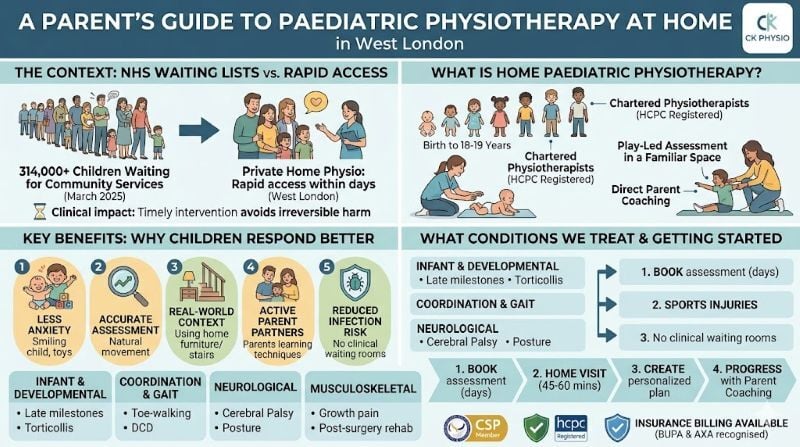
For many families across Hanwell, Ealing, and the wider West London area, the search for paediatric physiotherapy starts with a worry — a baby not yet rolling, a toddler walking on tiptoes, a school-age child whose knees ache during football, or a teenager recovering from surgery. It ends, far too often, with a long wait. As of March 2025, more than 314,000 children in England were waiting for community health services, according to the Royal College of Paediatrics and Child Health, and the community paediatric services waiting list tripled between October 2022 and July 2025 according to the Nuffield Trust.
A Parent's Guide to Paediatric Physiotherapy at Home
Paediatric physiotherapy at home offers an alternative route — one where children are assessed and treated in the environment they trust most, by Chartered Physiotherapists who tailor every session to the child in front of them. This guide explains what home-based paediatric physiotherapy involves, the conditions it can address, what families can expect, and how to access this care in West London.
 What is paediatric physiotherapy at home?
Paediatric physiotherapy at home is specialist assessment and treatment delivered by a Chartered Physiotherapist within a child's home, nursery, or school. It covers children from birth to approximately 18–19 years of age — the scope defined by the Association of Paediatric Chartered Physiotherapists. Treatment is play-based, family-centred, and built around the child's developmental stage rather than adapted from adult protocols.
The home-delivery model differs from clinic-based care in three meaningful ways. The environment is familiar, which substantially reduces the clinical anxiety many young children experience around hospitals and consulting rooms. The physiotherapist observes how a child actually moves through real spaces — the stairs they climb, the play mat where tummy time happens, the bedroom they share with siblings — and uses this context to shape practical, sustainable treatment plans. And parents become active participants rather than waiting-room observers; they learn the techniques, understand the exercises, and continue progress between sessions.
All UK physiotherapists must hold Health and Care Professions Council (HCPC) registration. Many also hold voluntary membership of the Chartered Society of Physiotherapy (CSP), and those with additional paediatric experience may belong to the APCP. These credentials are the baseline marker of a regulated, evidence-based practitioner.
Why parents in West London are choosing home physio in 2026
Three trends help explain the shift toward private paediatric physiotherapy at home this year.
NHS waiting lists for children are at record levels. Analysis from the Royal College of Paediatrics and Child Health, published in May 2025, found that more than 314,000 children in England were waiting for community health services, with a 5% rise in a single month. Within community paediatrics specifically, the Nuffield Trust reported in October 2025 that the waiting list tripled between October 2022 and July 2025. West London NHS Trust's own children's physiotherapy service currently quotes 3–6 months for an initial appointment, with an apology for the impact on families.
The clinical consequences of waiting are now widely recognised. The Chartered Society of Physiotherapy publicly warned in January 2025 that long waits for paediatric physiotherapy are causing "irreversible harm" to children, particularly those with long-term conditions or developmental needs where timely intervention shapes lifelong outcomes.
Home-based delivery is uniquely well-suited to children. A familiar environment supports more accurate assessment, because children move and play more naturally when relaxed. For babies and very young children, home delivery also reduces exposure to busy waiting rooms during peak infection seasons — a practical concern for any family with a newborn or medically vulnerable child. Private home physiotherapy isn't a replacement for NHS care; it sits alongside it. Many families use both.
What conditions does paediatric physiotherapy at home treat?
Paediatric physiotherapy covers a far broader range of conditions than many parents realise. The APCP groups them across several clinical categories, all of which can typically be assessed and treated in a home setting.
Infant & developmental conditions
Torticollis (tight neck muscles, often paired with positional plagiocephaly), talipes (clubfoot, positional or structural), Erb's palsy, developmental dysplasia of the hip, late motor milestones (delayed rolling, sitting, crawling, or walking), and tummy-time tolerance difficulties.
Developmental coordination & movement disorders
Developmental coordination disorder (DCD/dyspraxia), gross motor delay, hypermobility causing pain or functional limitation, balance and coordination difficulties, and gait variations such as toe-walking, in-toeing, or persistent flat feet beyond the typical age range.
Neurological & neuromuscular conditions
Cerebral palsy, muscular dystrophy (including Duchenne and Becker's), spina bifida, acquired brain injury, and other neuromuscular conditions where regular, expert physiotherapy supports posture, strength, and function over time.
Musculoskeletal & growth-related conditions
Osgood-Schlatter disease and Sever's disease (both common in active children), juvenile idiopathic arthritis, back and neck pain, sprains and strains, post-fracture rehabilitation, and post-orthopaedic-surgery recovery.
Sports injuries in older children & teenagers
Ankle sprains, knee pain, growth-plate-related injuries, hypermobility-related instability, and structured return-to-sport rehabilitation.
Respiratory conditions
Supportive physiotherapy for children with cystic fibrosis or other long-term respiratory needs, alongside the child's medical care team.
If your child's specific concern isn't listed here, an initial assessment with a Chartered Physiotherapist will determine whether physiotherapy is appropriate, whether home-based care suits the presentation, and whether any other specialist input may be needed. Our wider paediatric physiotherapy treatment and methods guide explains the underlying clinical approach in more depth.
Why children often respond better to physiotherapy at home
Children process unfamiliar environments very differently from adults, and clinical settings can create real barriers to effective treatment. A substantial proportion of young children — particularly those aged 2 to 5 — experience anxiety around medical appointments. That anxiety can shape sleep, behaviour, and willingness to engage with a clinician on the day.
Home delivery addresses this in three practical ways.
A relaxed child gives a more accurate assessment. When children feel safe, they move naturally, communicate openly, and engage with the play-based tasks the physiotherapist uses to evaluate motor skills, strength, balance, and coordination. A guarded child in a busy clinic provides far less clinical information — which can mean missed nuance and a less precise treatment plan.
Treatment fits the child's real world. A home assessment lets the Chartered Physiotherapist see the specific stairs a child has to climb, the bed they need to transfer from, the play area where their motor skills develop. Exercises can be prescribed using furniture and items already in the house, which makes the home exercise programme far more likely to be followed consistently.
Parents become genuine partners in care. In a clinic, parents often watch from a chair. At home, parents are coached through positioning, handling, and exercises directly. For conditions that require daily input — torticollis stretches, tummy time progressions, hypermobility management — parent confidence is often the single most important driver of long-term progress.
What happens during a home visit for a child?
A typical first home visit lasts 45–60 minutes, depending on the child's age and presentation.
The conversation comes first. The Chartered Physiotherapist spends time with the parents or carers — and the child, where age-appropriate — discussing birth and developmental history, current concerns, input from a GP, health visitor, or paediatrician, and the family's goals.
Assessment is play-based. Rather than a formal examination, the physiotherapist uses age-appropriate play and observation to assess motor skills, range of movement, strength, balance, coordination, posture, and gait. For babies, this might involve floor play and tummy-time observation. For school-age children, it might look like a game that is actually a structured movement screen.
Treatment begins where appropriate. Gentle hands-on techniques, positioning advice, or specific play activities may start during the first visit. The physiotherapist then explains the plan: recommended frequency and number of sessions, expected duration, and what progress will look like.
The home exercise programme is built. Parents are shown the exercises they'll continue between visits, with written and visual instructions. Fewer, well-executed exercises produce better outcomes than long lists — so the focus is on quality, consistency, and confidence, not volume.
Follow-up and joined-up care. With your consent, the physiotherapist can communicate with your child's GP, paediatrician, school, or nursery to keep care coordinated. This matters most for children with complex conditions, ongoing consultant input, or special educational needs. Our broader physiotherapy treatment and rehabilitation for children article covers our wider paediatric practice.
Play-based exercises parents can try at home
Catch with a soft ball builds hand-eye coordination and bilateral motor planning. Vary throw speed and height to suit the child.
Simon Says embeds prescribed movements (foot rotations, leg lifts, balance holds) inside a game, which significantly improves engagement and compliance with a treatment plan.
Traffic Lights uses "green" for running or jogging on the spot, "amber" for a light jog, and "red" to stop. It builds cardiovascular fitness, listening skills, and motor control simultaneously.
Animal walking — bear crawls, frog jumps, crab walks, and snake slithers — works different muscle groups and develops coordination without ever feeling like exercise.
Bubble popping is excellent for younger children. It develops visual tracking, balance, and gross motor reach. Pop bubbles with elbows, knees, or toes for variation.
Dancing builds cardiovascular fitness, rhythm, and coordination — with the added benefit that most children will choose to do more of it.
For specific conditions — torticollis, talipes, hypermobility, DCD, or any neurological condition — exercises should be prescribed and reviewed by a Chartered Physiotherapist. Generic exercises are not a substitute for a tailored programme.
How much does paediatric physiotherapy cost in London?
Cost varies meaningfully across NHS, private clinic, and private home-visit options. The table below summarises typical 2026 ranges across London.
| Option | Typical cost (London) | Wait time | Notes |
|---|---|---|---|
| NHS community paediatric physio | Free | 3–6 months (West London NHS Trust); waiting list tripled since 2022 nationally | Referral required (GP, health visitor, paediatrician) |
| Private paediatric clinic session | £80–£150 initial; £80–£120 follow-up | Days to 1–2 weeks | Specialist paediatric pricing typically above general MSK |
| Private paediatric home visit (London) | £100–£150+ initial; £75–£150 follow-up | Typically within days | No travel; familiar environment; flexible scheduling |
| CK Physio paediatric home visit (West London) | Competitive London pricing; insurance billing available | Typically within days | HCPC-registered Chartered Physiotherapists; BUPA & AXA recognised; Hanwell, Ealing & surrounds |
Most major private medical insurers — including BUPA and AXA — cover paediatric physiotherapy under children's policies, though specific coverage depends on the policy and may require GP referral. Families should check their policy or contact their insurer to confirm session limits, home-visit cover, and any pre-authorisation requirements.
For current CK Physio paediatric home-visit pricing, including initial assessment and follow-up rates, please contact our team. We'll confirm availability, the recommended session frequency for your child's specific needs, and whether your insurance covers treatment.
How CK Physio's paediatric home-visit service works
CK Physio has provided physiotherapy across West London since 2003, with home-visit services designed around Hanwell, Ealing, and the surrounding areas. Our team are HCPC-registered Chartered Physiotherapists, and we are recognised by major private medical insurers including BUPA and AXA. Our wider home visit physiotherapy guide covers home-based care across all age groups in depth.
Booking and access. Contact us by phone, email, or through our website. We'll discuss your child's specific needs, confirm whether home-based care suits the presentation, and arrange the initial assessment — typically within days rather than weeks.
The first visit. Your child is assessed in your home in a 45–60 minute session, with both parents or carers welcome and encouraged to participate. We use play-based assessment appropriate to the child's age and developmental stage, and we discuss findings and the recommended plan before leaving.
Treatment frequency. Most children benefit from weekly or fortnightly sessions during active treatment, with frequency reducing as goals are met. Some conditions — such as cerebral palsy or muscular dystrophy — benefit from longer-term, periodic input. Others, such as Sever's disease or a sports injury, typically resolve within a defined treatment block.
Coordinated care. With your consent, we communicate with your child's GP, paediatrician, health visitor, school, or nursery to keep everyone aligned. This matters most for children with complex conditions, ongoing consultant input, or special educational needs.
Insurance and payment. We bill major insurers directly where your policy permits. For self-pay families, we offer transparent pricing and honest advice about treatment frequency — we'd rather have you book the right number of sessions than the maximum number.
What if you're not yet ready to book?
For parents weighing options, several CK Physio resources may help. Our home visit physiotherapy guide covers home-based care across all age groups. Our paediatric physiotherapy treatment and methods article explains the clinical approach in more depth, and our physiotherapy treatment and rehabilitation for children article covers our wider paediatric practice. Our physiotherapy treatments page outlines our overall clinical approach, and our about page introduces the team and our philosophy. Parents considering postnatal recovery alongside paediatric care may also find our managing pregnancy discomfort guide useful.
For NHS referrals, your GP, health visitor, or paediatrician can refer your child to local community paediatric physiotherapy services. Private care can run alongside NHS care — it doesn't replace it.
Ready to arrange a home-visit assessment?
CK Physio's Chartered Physiotherapists bring paediatric expertise directly to your home in Hanwell, Ealing, and surrounding West London areas. Rapid access, play-based assessment, and parent coaching that supports your child between sessions.
Frequently asked questions
At what age can children have physiotherapy?
Paediatric physiotherapy covers children from birth to around 18–19 years of age. Babies as young as a few weeks old are commonly seen for conditions such as torticollis, plagiocephaly, or early developmental concerns. The right assessment and treatment depends entirely on the child's age, condition, and goals.
How long is the NHS paediatric physiotherapy waiting list?
Waiting times vary by area but are at record levels in 2025–2026. The RCPCH reported over 314,000 children waiting for community health services in March 2025, and the Nuffield Trust documented that the community paediatric services waiting list tripled between October 2022 and July 2025. West London NHS Trust currently quotes 3–6 months for an initial paediatric physiotherapy appointment.
Does private health insurance cover paediatric physiotherapy?
Most major insurers including BUPA and AXA cover paediatric physiotherapy under children's policies, though specific coverage varies and some policies require GP referral. Check your policy for paediatric physiotherapy cover, session limits, and whether home visits are included. CK Physio bills BUPA and AXA directly where policies permit.
Do I need a GP referral for private paediatric physiotherapy?
For self-pay assessments, no — parents can book directly with a Chartered Physiotherapist. Insurance policies often do require GP referral before treatment is reimbursed, so check this before booking. For complex or undiagnosed conditions, we often recommend involving the GP regardless, to coordinate care across services.
Is paediatric physiotherapy at home as effective as clinic-based care?
For most paediatric conditions, yes. The home environment supports more accurate assessment because children move more naturally when relaxed, and parent coaching is more direct in real-world settings. Some conditions involving specialist equipment (such as hydrotherapy) may still require occasional clinic or hospital input alongside home-based care.
How many sessions will my child need?
This depends on the condition. Acute issues such as a sports injury or mild positional torticollis may resolve in 4–8 sessions. Developmental conditions such as DCD or hypermobility may benefit from regular input over several months. Long-term conditions involve ongoing periodic care. Your Chartered Physiotherapist will give a realistic estimate after the initial assessment.
Can the physiotherapist work with my child's school or nursery?
Yes, with your consent. Many children — particularly those with developmental, neurological, or coordination conditions — benefit from joined-up care across home, nursery, and school. We can liaise with teachers, SENCOs, and other professionals where helpful.
Paediatric physiotherapy at home gives families across West London a way to access expert, personalised care without the strain of long waits or unfamiliar clinical environments. For children, that often means faster engagement, less anxiety, and clearer progress. For parents, it means active participation in care that fits around the rest of family life. To discuss your child's needs and arrange an initial assessment in Hanwell, Ealing, or the surrounding area, get in touch with the CK Physio team.
References & further reading
- Royal College of Paediatrics and Child Health (May 2025). Report shows hundreds of thousands of children left waiting for vital community care services. rcpch.ac.uk
- Nuffield Trust (October 2025). How will waiting times in community health services affect the shift towards neighbourhood health? nuffieldtrust.org.uk
- Chartered Society of Physiotherapy (January 2025). Paediatric physios warn long waits causing 'irreversible harm' to children. csp.org.uk
- Association of Paediatric Chartered Physiotherapists. Paediatric Physiotherapy: scope, conditions and clinical standards. apcp.csp.org.uk
- Health and Care Professions Council. Physiotherapist registration verification. hcpc-uk.org
- West London NHS Trust. Children's services information. westlondon.nhs.uk
About the author
CK Physio Team
The CK Physiotherapy team comprises HCPC-registered Chartered Physiotherapists serving Hanwell, Ealing, and West London since 2003. We are members of the Chartered Society of Physiotherapy and recognised by major private medical insurers including BUPA and AXA PPP. Learn more on our about page.
This article is for general information and does not replace individual clinical assessment. If you have concerns about your child's health or development, consult a Chartered Physiotherapist, GP, or relevant healthcare professional.




.svg)

.svg)

.svg)